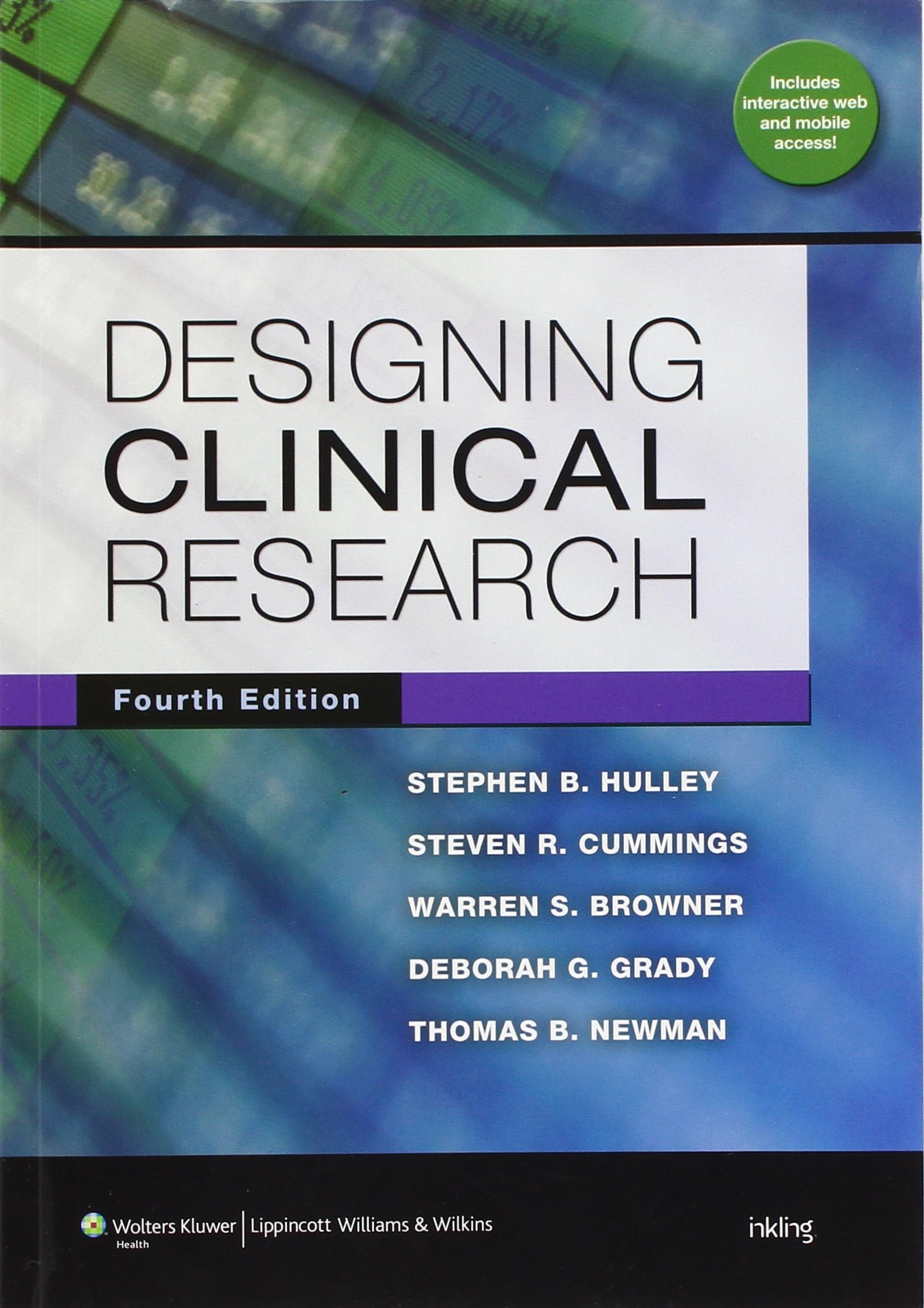

Designing Clinical Research
Product ID: 1700267
Buy anything from 5,000+ international stores. One checkout price. No surprise fees. Join 2M+ shoppers on Desertcart.
Desertcart purchases this item on your behalf and handles shipping, customs, and support to Kyrgyzstan.
Full description not available
D**Y
Great Text on Trials
Clinical Trials have evolved over the past few decades in multiple dimensions. There are legal, regulatory, statistical, procedural, and clinical dimensions which tend to structure them in ways which were not prevalent to anyone who entered medicine decades earlier. The book by Hulley et al, Designing Clinical Research, is a wonderful overview of most of these dimensions. It brings the reader up to date with many of the key factors which have become part of Trials and give an excellent amount of depth so that the book stands on its own.The book is divided into three major sections; (i) Basics including sampling, trial hypotheses testing and statistical analyses as well and general trial types. (ii) Designs which examines the various types of trials from randomized case control, cross-sectional, and other such classic trial methodologies, (iii) Implementation, including the ethical issues and data management.The Basics provides a reasonable overview of the randomization, sizing, and the establishment of the statistical plan for a Trial. The approach is classic with the null hypothesis approach and the metrics necessary for properly sizing a successful Trial. The presentation is in a summary nature and the reader is either expected to be familiar with the development of the mathematics or just to use the Tabular approaches as presented. There are excellent discussions on various approaches such as continuous versus dichotomous and the material is useful even for those well experienced in the area.The Designing sections go over the details associated with various Trial approaches and discuss the implementation, and the advantages and disadvantages. Again, even for someone already familiar with the material the authors provide added insight well worth the reading. Again when discussing such elements as likelihood designs and Receiver Operating Characteristics the material is of a summary nature, adequate for both understanding and application but not of any material depth. Yet that was never the objective of the book.Finally in implementation the authors present an excellent discussion of the Ethical Issues that are frequently found in many Trials. There are other elements here as well but the Ethical discussions have become more prevalent to current day Trials.The challenge that this and other works on Trials will be facing are the Trial involving genome based approaches. For example in MDS and the use of demethylating therapeutics such as azacytidine and others one may ask the ethical question; if this is demethylating and methylation is both the cause while also being a control in other cells, how long should one wait to see long term effects? In cases such as the BRAF inhibitors in melanoma, what import is the extension of life if the costs are so great? Also how aggressively should one approach multiple drug therapies? Finally, as we see more genetically specific drugs on a patient by patient basis, can Trials like those discussed herein still be considered a gold standard and if not what then would take their place. Therapeutics targeted at a specific genome type will be difficult to analyze as we have with large Trials discussed in the book.Overall the book is a superb overview of Trials and is worth a read by finishing Med Students, Resident, and even those experienced in Trials. It is well written, logically laid out, considers almost all the key questions, and presents information adequate for most.
N**H
Concise and comprehensive book
This is a concise and precise book that gives a very good practical description to conduct various types of studies. Though the title is clinical research I believe it is also a good resource for epidemiologic research. After having read large books on how to conduct research this book is a relief. It does not dwell on extraneous stuff and focuses only the essentials and still manages to captivate the reader.
M**I
Great book, very well written
Absolutely essential for anyone working in clinical research. One of the best books I’ve ever had, cery well written.
E**D
A "must have" clinical research books.
Great for MDs or PhDs wanting to refresh their knowledge on how to design the strongest research methodology they can. Clearly written book discussing different study designs and their pros and cause when trying to establish a causal association between an exposure and a disease event (or intervention and reduced disease event). This book focuses on clinical research, but is often used in public health courses that deal with general community research as well.The fact that it's used often as a textbook is reflected in its very high price point.
E**S
Intellectually-Stimulating Genetic Research Textbook
I read this book during my clinical research studies. I continue reading it after graduation. I always look forward to the re-introduction of the material. At the same time, I learn something new from the book. I would highly recommend it to clinical research students. It is an excellent required and recommended textbook.
F**G
This is the go to manual for the IRB professional
A very current and thorough treatment of clinical research design by recognized experts in the field. A handy compendium with immediate utility when engaged in the ethics review of clinical research.
H**S
Excellent book.
An excellent book. Clearly written, very concise. It guides you step by step in designing clinical research. It covers basic points usually underestimated in other books and some critical points as grant proposals.
G**L
Excellent book.
This book is excellent in the way it approaches the research subject in the medical field. If you want to learn about clinical research, this is a most.
Trustpilot
3 weeks ago
1 month ago